What art brings about
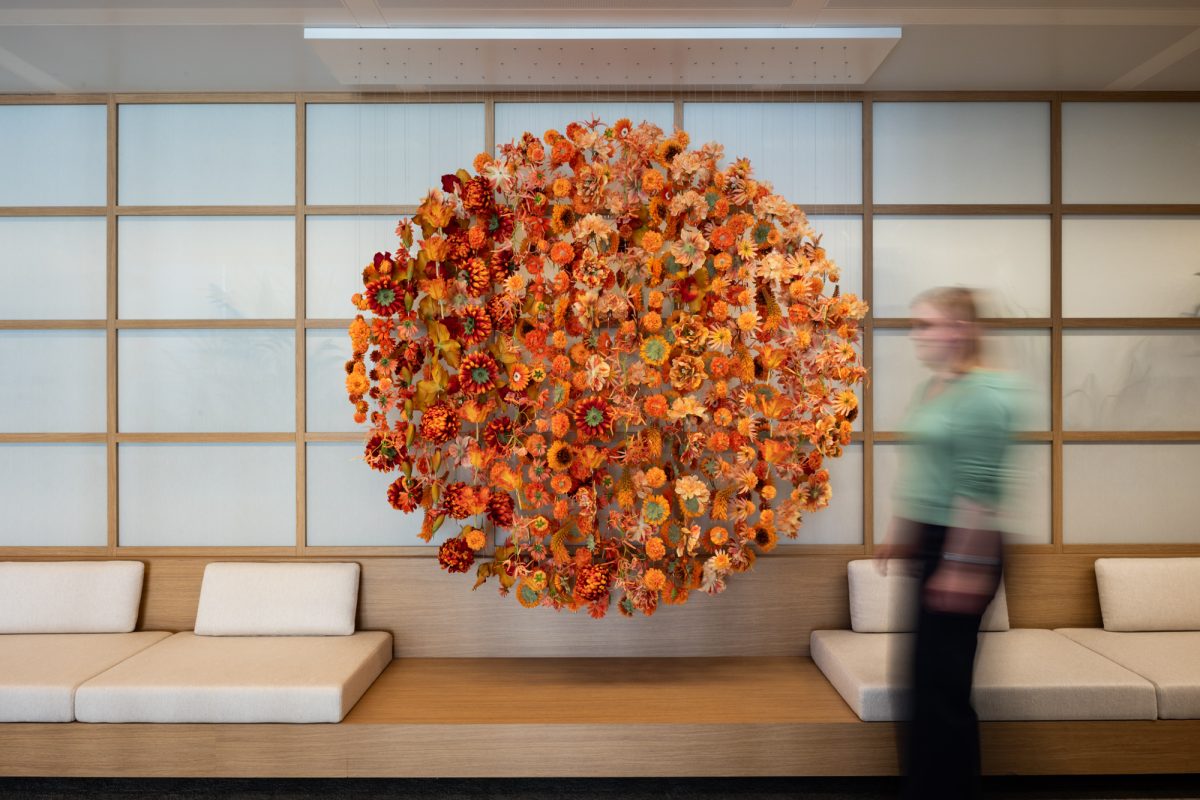
We see art doing three things. For guests, it softens the experience. Think of a law firm, where visitors sometimes arrive with knocking knees: an artwork at the entrance gives them something to look at and something to talk about. That conversation might be a personal interpretation of the work with a story of its own, or a hook to showcase your organisation’s philosophy. And perhaps your guest sees it differently again. Plenty to talk about for a pleasant welcome. It works for guests without knocking knees too: an artwork can immediately say something about your organisation.
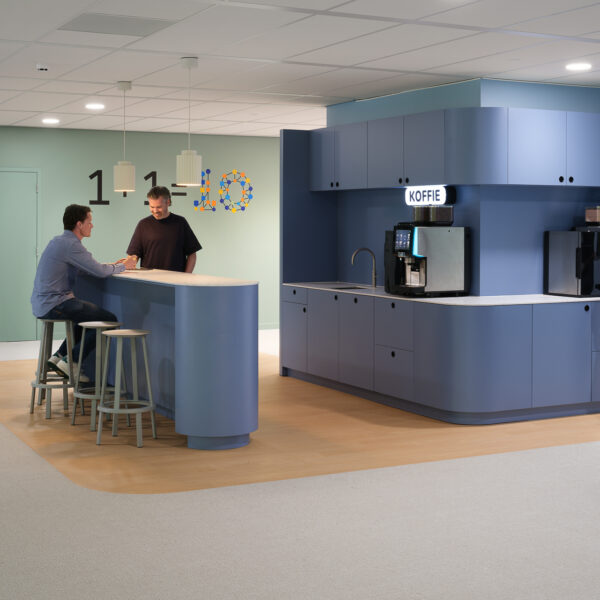
For employees, art works in several ways. Naturally, it makes the office more beautiful, for example in the lunch area, where people take a moment to unwind anyway and can enjoy a creation. But art can also do some of the work! One of our clients deliberately uses it to help employees with demanding thinking. Looking up from your desk at a work of art can sometimes give you a fresh perspective on a problem. And what applies to guests applies to colleagues too: a good conversation. “How is this art? I thought it was a side table!” A provocative piece that chafes a little always gets people talking at the coffee machine.
Then there’s society. Supporting local and young artists gives them a platform and an income. A rotating collection is ideally suited to this, preferably with a ceremonial opening where artists and employees meet.
Art as a jewel
Some clients have a full jewellery box: a collection with real pearls, built up over the years. But often the jewellery box is empty. A move to a new location could then be a good occasion to acquire a work to mark the moment. A refurbishment is a costly affair in itself. Looked at the other way round, the cost of an artwork is actually modest by comparison. You could, for example, set aside a percentage of your refurbishment budget for it. The Dutch government does this as well: when central government buildings are built, refurbished or renovated, between 0.5% and 2% of the construction budget is spent on art.
Once the budget is there, the question is how to spend it well. Who makes the choice? After a misstep at our own office, we know one thing for sure: it shouldn’t be a one-person decision. Building a collection works better with outside advice or with colleagues involved. Start with the key question: what is the art’s purpose, as described above? Taste is personal, and an office belongs to everyone. Choose the purpose first, and only then the work.
We can help with the selection and execution. Recently, for example, we introduced a Japanese bank to a Japanese-Dutch artist couple. The bank wanted an artwork that reflected both its Japanese roots and Dutch values. We don’t make art, but we do have a network. We put artists forward and decide together where the work can shine. Then we brief the artist, so the work suits both the space and the story.
The right place
The tricky thing about the modern office: there are hardly any private offices left. And the walls that do remain are usually made of glass. Transparency and light are often the goal, and the one wall left over is home to a screen for hybrid meetings. So where do you hang a painting?
That’s exactly why art belongs in the workplace concept. Decide early on where the art’s purpose will come into its own, and include that in the first steps of defining your accommodation requirements. What does the company want to achieve with it? Impact at the entrance? Calm at lunch? Inspiration at the workstations?
Good interior design serves the art. A translucent wall with an airy mobile in front of it. A museum-like corridor with niches and smooth walls for a serious collection. Even the wall colour matters: historically, red was often used in palaces and museums, while today white is the museum colour. Although Adam Pendleton is shaking that up by painting the walls of the Stedelijk Museum black. Ideally, the colours of the interior and the artwork reinforce each other, with the art forming an integral part of the interior design.
“There’s no room,” we sometimes hear, but that’s rarely true. At one client, an artwork recently turned the stairwell by the emergency exit into a showcase. For this too, we brought in an artist specifically. The work had to meet practical requirements: fire-safe, no power for extra lighting, cleanable from the floor and removable at the end of the lease. A good artist knows how to work with constraints like these. And so a pointless circulation space became a hidden pearl and a real eye-catcher.
The practical side
Art also affects the execution of a refurbishment. Position spotlights so that a work is properly lit, rather than just catching grazing light. Even more important is that paintings are hung securely. That sounds obvious, but interior walls are usually hollow metal stud walls or partition systems that aren’t naturally suited to hanging art. Work for the project manager, who needs to factor this into the refurbishment from the outset. Is the art coming later? Then think now about how you’ll hang it.
Storytelling interiors
Is there really nothing, no collection, no budget, no ideas? Then we go for a rock-solid, distinctive interior design. Think of it as well-tailored, stylish clothing that looks beautiful and makes a statement even without jewellery, and conveys what your organisation stands for.
We’d love to visit you to discover your story. What is your goal? What do you want to convey? Are there jewels in your jewellery box that deserve a place? Or do you feel the office is missing something? We’d be happy to talk with you about creating an accommodation story that rings true.